Teeth Numbers Explained: Adult and Children’s Teeth
Teeth numbers help dentists identify each tooth for exams and treatment. Learn how teeth numbers work for adults and children with this simple guide.
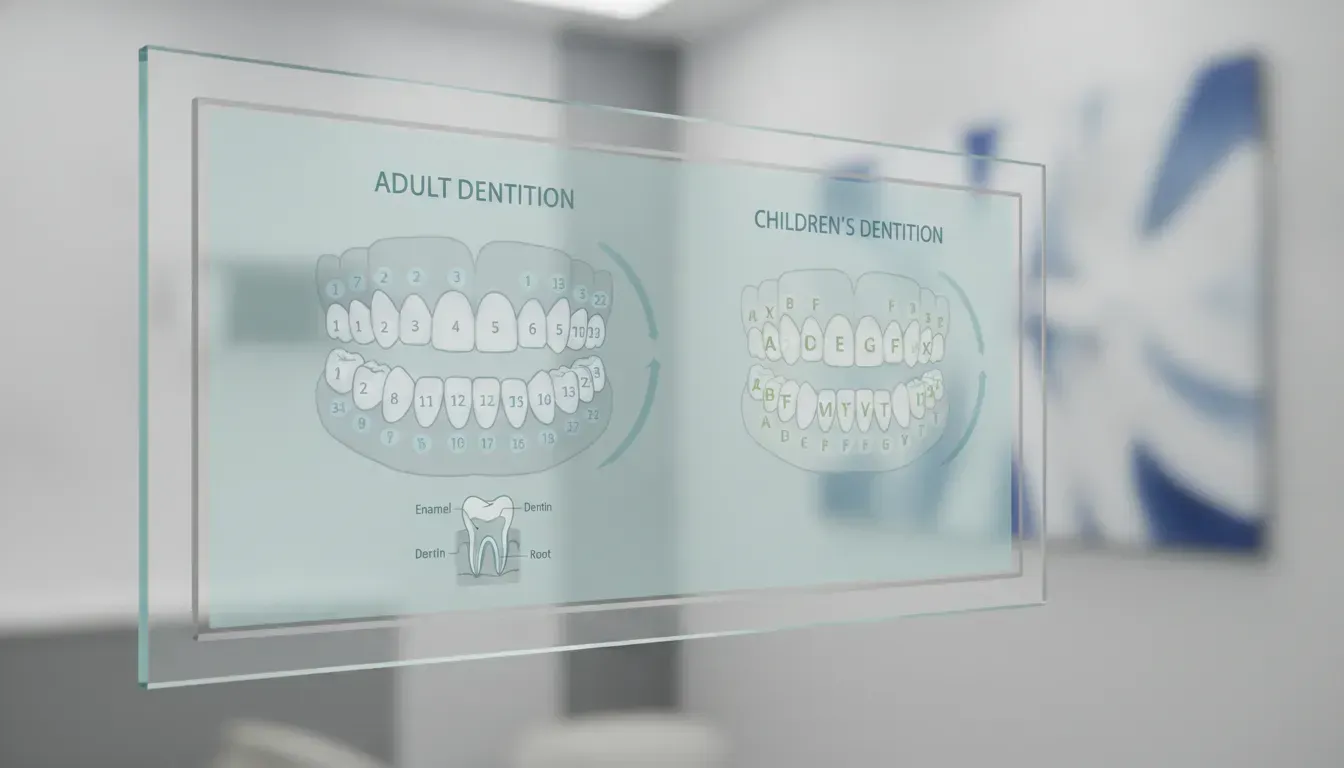
Your dental chart tells a story about your oral health, and teeth numbers help make sure every note refers to the right spot. They give your dentist and the rest of your care team a shared way to discuss a tooth, whether they’re tracking a routine exam or talking about a crown, extraction, or implant. But a number by itself is not a diagnosis, and charts don’t all use the same system. If you’ve ever wondered why one chart shows #1 through #32 while another uses letters or paired digits, this guide breaks down the differences and shows you how to read the labels.
Key Takeaways
- Tooth labels identify a tooth, not a diagnosis: Ask your dentist what any chart note means for your care.
- The Universal system uses numbers for adult teeth and letters for baby teeth: Permanent teeth run from #1 to #32; primary teeth run from A to T.
- FDI and Palmer notation show tooth locations in different ways: Check the chart’s orientation, then ask your dental team to point out the tooth if you’re unsure.
What Do Tooth Numbers Mean?
Tooth numbers are labels dentists use to identify specific teeth on a chart. They help your dental team refer to the same tooth when discussing an exam, treatment plan, or procedure. A number tells you which tooth is being identified, not whether it has a dental concern or what treatment it may need. Its exact meaning depends on the numbering system used on the chart.
Knowing the basic types of teeth can make dental charts easier to follow. Incisors, canines, premolars, and molars each have different roles in biting and chewing. Bain Dental & Aesthetics Group offers dental care for adults and children, with services tailored to patients’ needs at every stage of life.
Adult and primary tooth types and counts
Most adults have 32 permanent teeth: eight incisors at the front of the mouth, four canines, eight premolars, and 12 molars. Incisors cut food, canines help tear it, and premolars and molars help crush and grind. The 12 molars include four third molars, commonly called wisdom teeth. Some people have fewer than 32 teeth because wisdom teeth never developed or were removed.
Children typically have 20 primary teeth, also known as baby teeth: eight incisors, four canines, and eight molars. These teeth usually start appearing at around 4 months of age. Permanent teeth begin replacing them at about age 6, with the transition continuing into the early teen years. The Cleveland Clinic’s overview of tooth types can help families learn more about how teeth develop and what each type does. Regular dental visits also give your dentist a chance to monitor a child’s developing teeth and answer questions.
How Does the Universal Numbering System Map Teeth?
The Universal Numbering System gives each tooth a specific label, helping dental teams document findings and discuss care clearly. It uses numbers for permanent teeth and letters for primary, or baby, teeth. In both charts, the labels follow a set path around the upper and lower arches.
Map adult teeth #1–32 from the upper right around the mouth
The adult sequence starts at the upper right wisdom tooth, or third molar, labeled #1. It continues across the upper arch to the upper left wisdom tooth, #16. From there, it moves to the lower left wisdom tooth, #17, and follows the lower arch to the lower right wisdom tooth, #32.
This horseshoe-shaped order helps a dental team identify a specific tooth without relying on a description such as “the back tooth on the left.” Right and left refer to the patient’s own mouth, so the sides may appear reversed when you look at a chart. Olive Dental Group’s tooth-number chart shows the sequence across both arches. If you’re reviewing a dental chart, ask your dentist to point out the tooth number and its location.
Map primary teeth A–T from the upper-right second molar around the mouth
Primary teeth use letters rather than numbers. The sequence begins with A, the upper right second molar, then runs across the upper arch to J, the upper left second molar. It continues on the lower arch, starting with K at the lower left second molar and ending with T at the lower right second molar.
Since children typically have 20 primary teeth, the chart uses 20 letters, from A through T. Knowing the letter can help you follow which tooth the dentist is discussing during your child’s visit. Fisher Pointe Dental’s tooth chart illustrates how the letters map to primary teeth. If you’re unsure where a letter appears, ask the dental team to show you on the chart.
How Do FDI and Palmer Notation Compare?
FDI and Palmer notation both identify a tooth’s location, but they use different formats. FDI uses two digits. Palmer uses a number or letter paired with a small corner-shaped symbol. In both systems, the quadrant refers to the patient’s left or right, not the viewer’s, so a chart may look reversed when you’re facing it.
Read FDI notation: the first digit marks the quadrant; the second marks the tooth
For permanent teeth, the FDI system’s first digit identifies the quadrant: 1 is upper right, 2 is upper left, 3 is lower left, and 4 is lower right. The second digit shows the tooth’s position, counting from the center of the mouth toward the back. A 1 marks a central incisor; an 8 marks a third molar.
For example, 11 means the upper-right central incisor, while 36 means the lower-left first molar. Read the digits together to identify one specific tooth. The FDI tooth chart shows how each digit corresponds to a location. For primary teeth, FDI uses quadrant digits 5 through 8 and tooth-position digits 1 through 5.
Read Palmer notation: a number or letter and a symbol identify the tooth’s quadrant
Palmer notation counts teeth from the center of the mouth, like FDI, but identifies the quadrant with a corner-shaped symbol around or beside the tooth number or letter. For permanent teeth, the numbers run from 1 for the central incisor to 8 for the third molar. For primary teeth, the letters A through E follow the same center-to-back pattern.
The symbol’s orientation shows whether the tooth is in the upper or lower jaw and on the patient’s left or right. This can make Palmer notation easy to scan on a dental chart, though the symbols may not display clearly in plain text. A tooth-number chart can help you compare how the two systems show tooth location. If you’re unsure what a mark means, ask your dental team to identify the tooth on the chart.
How Do Tooth Numbers Help With Dental Care?
Tooth numbers give your dental team a consistent way to identify a specific tooth. A dental chart uses these numbers or codes to record observations, treatments, and changes over time. That shared reference helps clinicians communicate clearly when discussing a cavity, crown, extraction, implant, or another part of your care. It can also help you follow along during an appointment or understand which tooth a note refers to in your records.
The number alone does not tell the whole story. Its meaning depends on the numbering system used, and the chart’s layout can affect how you match a tooth to your mouth. The Universal system numbers adult teeth and uses letters for primary teeth; FDI and Palmer notation use other formats. If you have questions about a chart, ask your dentist to walk you through it. At Bain Dental & Aesthetics Group, your care team can explain how chart notes relate to your dental care.
Check the chart’s orientation and numbering system, and ask what a number means: numbers identify teeth, not diagnoses
First, check how the chart is oriented. Many charts show the teeth from the patient’s perspective, meaning the right side of the image may correspond to your right side. Layouts can vary, so confirm the orientation with your dental team before matching a number to a tooth.
Next, find out which numbering system the chart uses. In the Universal system, adult tooth #1 is the upper-right wisdom tooth, and the count continues around the mouth. A number identifies a tooth; it does not explain a finding or treatment plan. Ask whether a chart entry describes a condition, past treatment, or recommended care. Dental charts help teams record and communicate tooth information, and your dentist can explain what each note means for you.
Frequently Asked Questions
Does a higher tooth number mean a tooth has a problem? No. A tooth number is simply an identifier used on a dental chart. Your dentist will explain any notes about a concern, past treatment, or recommended care separately.
Why might the same tooth have different labels on different charts? Dental offices may use different numbering systems, such as Universal, FDI, or Palmer notation. Each system labels teeth in its own way, so check which one the chart uses before interpreting a label.
How can I tell which side of my mouth a chart shows? Charts often use your perspective, so the right side of the image may represent the right side of your mouth. Since layouts can differ, ask your dental team to show you how to read the chart.
Do children’s teeth use the same numbers as adult teeth? Not always. In the Universal system, primary teeth are labeled with letters A through T, while permanent teeth use numbers. Your child’s chart may use another system, so the labels can look different.
Can Bain Dental & Aesthetics Group explain a tooth number on my chart? Yes. Your care team can point out the tooth’s location and explain what any related chart notes mean. Bain Dental & Aesthetics Group sees patients at its Bowdon, Carrollton, and Villa Rica locations.